Foundations for a timber frame house — slab, strip or pad?
Which foundation for a timber frame house? We compare slab, strip and pad foundations — when each type works best, what to watch out for, and how to plan contractor cooperation.
A timber frame house is light — but the foundation beneath it must be just as solid as under any other building. The difference is that lower structural loads open more options. In this article we compare the three most popular solutions: slab, strip and pad foundations, and help you decide which works best.
Why is the foundation so important?
The foundation transfers building loads to the ground. Even a lightweight timber frame house (approx. 30–50 kg/m² for an external wall) needs a stable base that doesn't settle unevenly. Differential settlement is the main enemy — it leads to cracked finishes, sticking windows and doors, and in extreme cases structural damage.
Concrete slab foundation
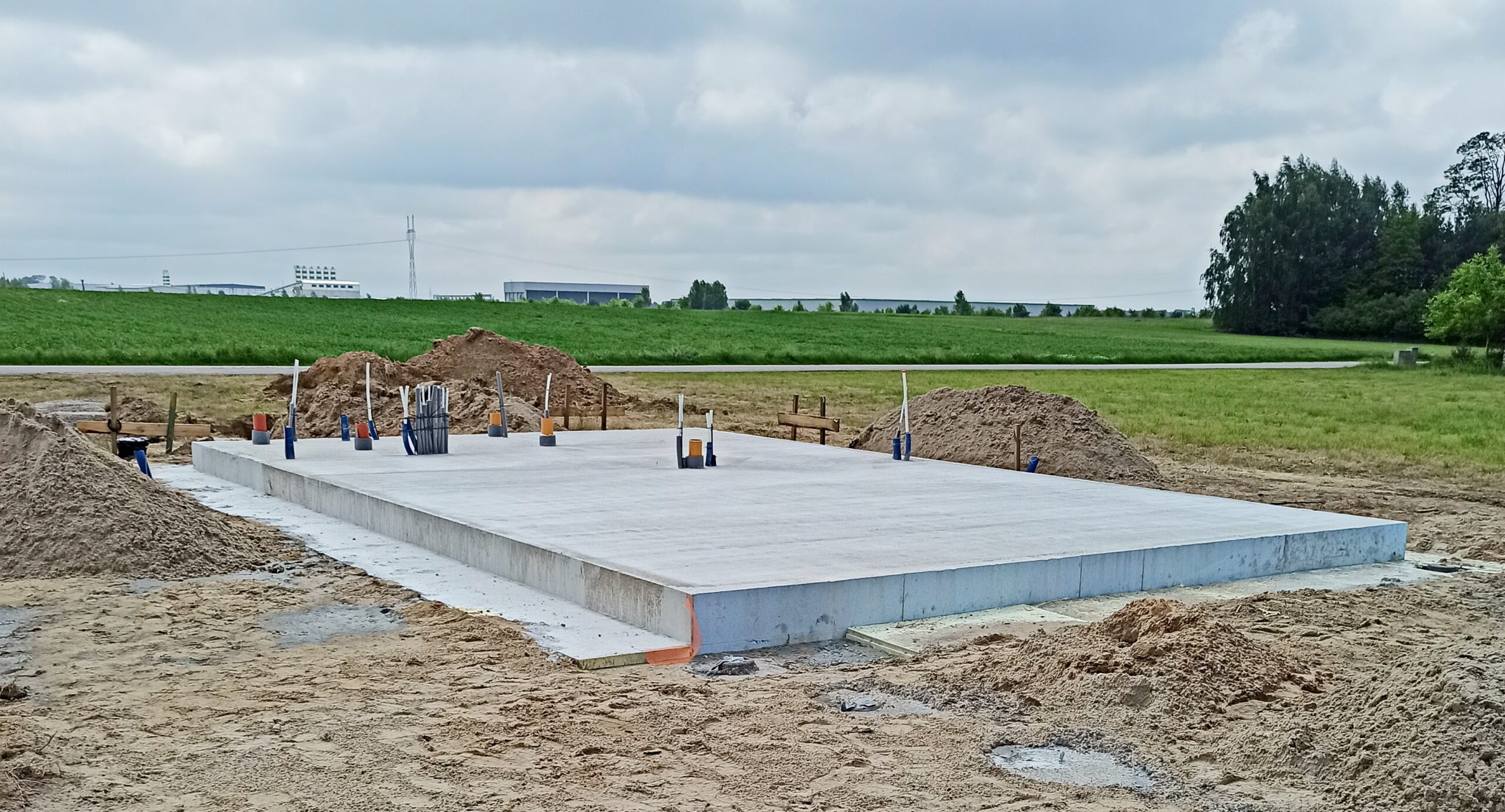
A slab foundation is a monolithic reinforced-concrete structure, usually 20–30 cm thick, poured directly on the ground over insulation and a gravel bed. It is currently the most popular choice for timber frame and modular houses in Poland.
Advantages of a slab foundation
- Even load distribution — ideal for soils with variable bearing capacity
- Fast construction — 2 to 4 weeks (after excavation and soil survey)
- Ready ground-floor surface — no additional screed needed
- Easy integration of underfloor heating within the slab
- No thermal bridges with proper insulation
- Utility runs (drainage, water) laid before the pour
When does a slab work best?
- Single-storey and storey-plus-attic homes — the most common choice
- Soils with low or variable bearing capacity (clay, peat, fill)
- High water-table sites
- Buildings without a basement (most timber frame houses)
- Investors who value speed and simplicity
Strip foundations
Strip foundations are concrete beams running beneath load-bearing walls, usually at a depth of 80–120 cm (below the frost line). Between the strips, foundation walls and a floor slab on grade are constructed.
Advantages of strip foundations
- Proven solution familiar to every building crew
- Lower concrete volume than a full slab
- Allows for a cellar or partial basement
- Performs well on soils with good bearing capacity
When do strips work best?
- Good, uniform bearing-capacity soils (sand, gravel)
- Buildings with a basement
- Sites with a low water table
- Projects that specify this foundation type
Pad foundations
Pads are point foundations under structural posts. In timber frame construction they are used less often — mainly for lightweight structures: terrace canopies, verandas, and small holiday cabins on stilts (e.g. on slopes).
When pads?
- Lightweight ancillary structures (pergolas, terraces, gazebos)
- Sloped sites — houses on stilts / platforms
- Temporary or seasonal structures
Foundation type comparison
What to know before choosing a foundation
- Geotechnical soil survey — the absolute baseline. No designer can choose the right foundation without it. The survey cost is a fraction of fixing a wrongly chosen foundation.
- Water-table level — high groundwater rules out simple strips without extra waterproofing; a slab copes much better.
- Frost depth — 0.8–1.4 m in Poland depending on region. The foundation must be below it or adequately insulated.
- Thermal insulation — 15–30 cm of XPS polystyrene (λ ≤ 0.034 W/mK) under a slab eliminates the thermal bridge through the floor.
- Utilities — drainage, water, electricity must be planned and routed before pouring the slab. Later changes are expensive.
Who builds the foundation?
The foundation is built on site, so it is typically carried out by a local contractor (concrete firm) chosen by the investor. Wood Solutions can recommend trusted partners in your region or help coordinate the work — ensuring the foundation is ready in time for the factory-built structure delivery.
Important: the dimensions and placement of anchor bolts must precisely match the timber frame design. Close coordination between the foundation contractor and the house supplier is therefore essential — we provide a complete set of technical documentation for the foundation.
Summary
For most single-storey and storey-plus-attic timber frame houses, a concrete slab foundation is the best choice — fast, energy-efficient, and free from differential-settlement risks. Strip foundations suit sites with good soil and projects that include a basement. Pads are for ancillary structures.