Timber frame vs masonry house — which to choose in 2026?
Build time, cost per m², energy efficiency, durability, mortgage — check 7 objective criteria comparing a timber frame house with a masonry one.
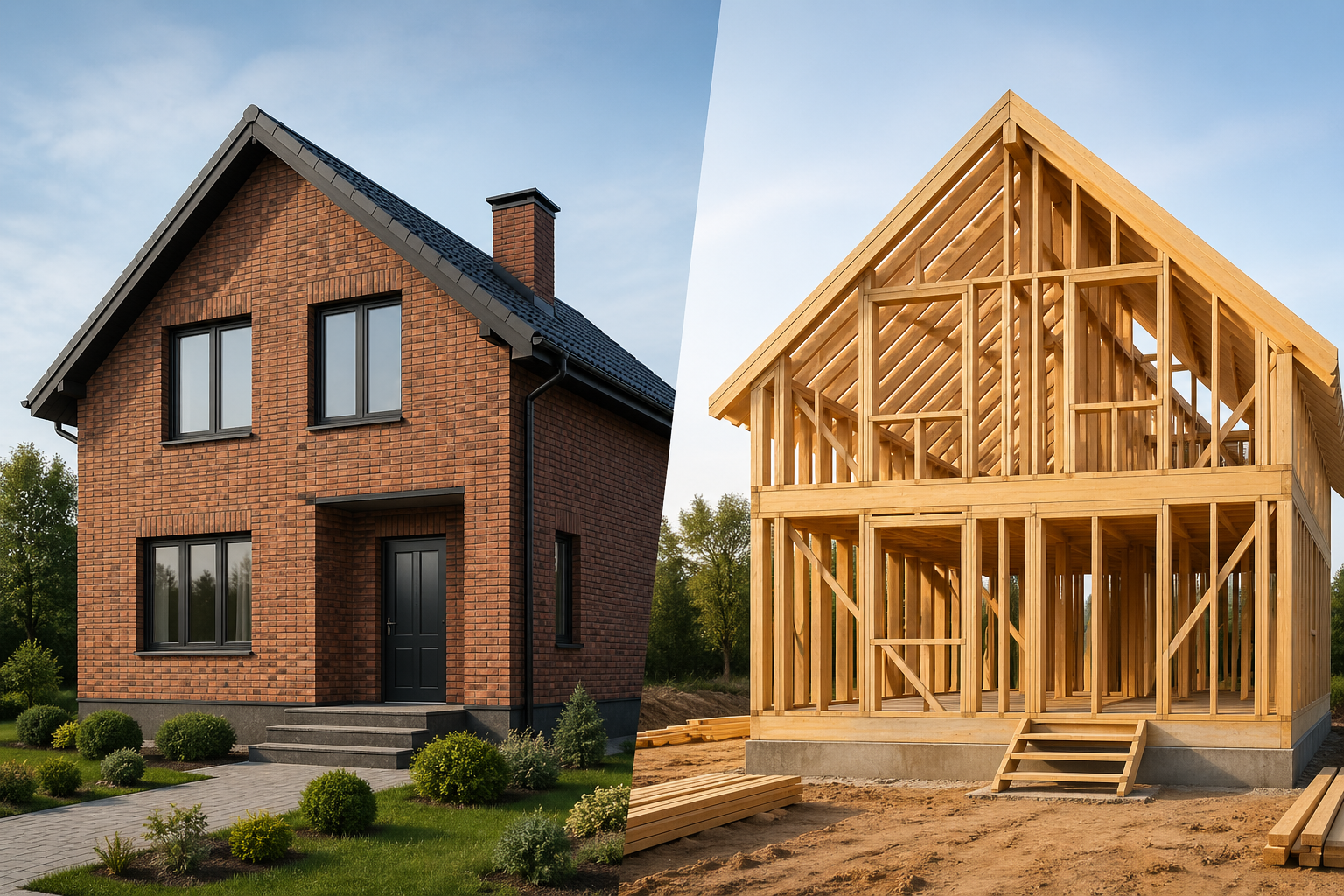
The most common question of investors in 2026. We show an unbiased comparison of both technologies in seven key areas — no marketing, just real numbers from our 290+ deliveries.
1. Build time — the key difference
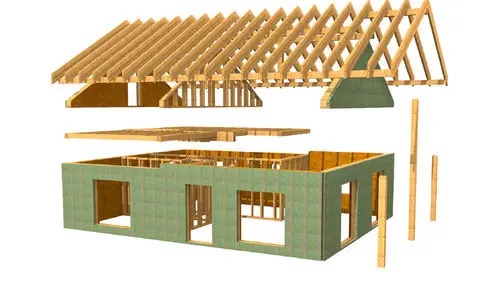
A turnkey masonry house: 14–18 months from permit to handover. A timber frame house in Wood Solutions prefab technology: 3–5 months from contract, including 7–10 working days of on-site assembly. The reason: walls are produced in factory in parallel with foundation, no concrete curing seasonality, no winter breaks.
2. Cost per m²
Full comparison (labour, materials, finishing):
- Standard masonry house — €1,040–1,500/m².
- Wood Solutions self-assembly kit — €305/m².
- Wood Solutions delivery & assembly (open shell) — €420/m².
- Wood Solutions developer standard — €810/m² (most popular package).
- Wood Solutions turnkey — individual pricing.
On 120 m² the saving is typically €18,000–28,000 — enough for a heat pump and full PV system in the turnkey package.
3. Energy efficiency
A Wood Solutions wall has U = 0.13 W/(m²K) (200 mm mineral wool + installation grid) at ~30 cm total thickness. A comparable masonry wall: 25 cm Poroterm + 20 cm wool = 45 cm and U ≈ 0.17. Conclusion: better thermal comfort with 33% thinner wall — more usable area on the same plot.
4. Durability — the „wood rots“ myth
Timber frame houses in Norway and Sweden are 100–150 years old and still fully in use. The key: no contact between wood and water/ground, isolation from foundation, kiln drying + KVH treatment. Estimated lifespan: above 100 years with standard facade maintenance.
5. Acoustics
The myth that “you hear everything in a frame house” concerns pre-1990 buildings. A modern Wood Solutions wall has Rw ≈ 47 dB acoustic insulation — comparable to 25 cm Poroterm. Key: double-layer panels + mineral wool between studs.
6. Mortgage
All Polish banks finance timber frame construction. Required documentation is the same as for masonry. Some banks (PKO BP, Santander, ING) treat frame houses preferentially due to shorter build time = lower risk of unfinished investment.
7. Fire — facts instead of fear
KVH C24 timber has fire resistance class REI 30–60 minutes (with GK boarding even REI 90). A steel frame loses load-bearing capacity instantly in fire — wood burns from outside but works structurally much longer, giving time for evacuation.